De la Garza ranch
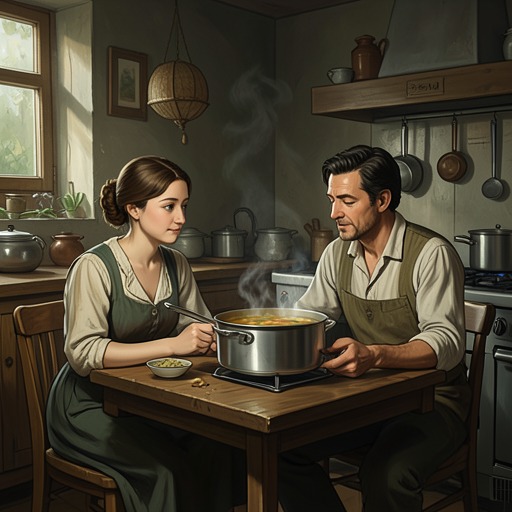
Like Water for ChocolateThe De la Garza ranch is the family home and the defining landscape of Tita’s early life. Its rooms and working spaces organize both practical labor and emotional memory: the kitchen becomes Tita’s first realm, while the dining room gathers the women for shared work and the patio and roof dovecote connect domestic life to the wider world. The ranch is not simply a backdrop to family events. Its routines sustain the household, and its boundaries shape who belongs, who moves freely, and what can be remembered.
Setting and Household
After Tita’s father died when she was two days old, Mama Elena’s milk dried up. With no wet nurse available, Nacha took responsibility for feeding the infant, while Mama Elena faced mourning and the work of running the ranch. Tita grew up on teas and thin corn gruels, cared for in the kitchen and closely attuned to its daily schedule. The household’s food and education depended on the ranch’s work, making the estate a place of both family authority and material provision.
The ranch’s domestic spaces extended beyond the kitchen. The enormous house included a dining room where the women assembled for food preparation, a patio, and kitchen and herb gardens. For Tita, the door between the kitchen and the rest of the house marked a boundary between a familiar domain and a larger world she found difficult to comprehend. The kitchen side of that threshold, extending through the garden doors, was the part of the household she considered her own. Her sisters, Rosaura and Gertrudis, regarded the kitchen differently: its activity could seem strange or dangerous to them, even when Tita treated it as a place for play and discovery.
Work and Family Rituals
The ranch’s routines were organized around food, shared labor, and Mama Elena’s authority. During sausage making, the women of the household gathered around the dining-room table: Mama Elena, her daughters Tita, Rosaura, and Gertrudis, Nacha, and Chencha. They prepared garlic, chiles, and spices together, talking and joking as they worked. When Mama Elena ended the day’s work, the household shifted at once to its assigned evening tasks, including collecting the chickens, drawing water from the well, and gathering stove wood. Other activities gave way to the demands of the ranch’s food production.
The kitchen also shaped Tita’s understanding of time and memory. She recognized the daily stages of household work through its smells and sounds, and food could return her to earlier moments. The ranch’s recipes therefore carried more than practical knowledge: they linked family history to repeated acts of preparation. Later, Gertrudis reflected that neither she nor Rosaura knew how to make the family recipes, and that the family’s past would disappear with Tita if no one preserved them. The ranch’s domestic labor thus served as a means of transmitting memory across generations.
The Ranch During the Revolution
The Mexican Revolutionary Army’s arrival disrupted the ranch’s ordinary work and sharpened the risks attached to its isolation. Food scarcity had already forced the household to slaughter animals it depended on. Nicholas, the manager, had gone to buy replacement cattle with two workers, while Felipe was sent to San Antonio, Texas, to seek news of Pedro and his family. At the ranch, Mama Elena, Tita, Chencha, and two farmhands remained. When Rosalio reported that soldiers were approaching, Mama Elena prepared to protect the household and ordered Tita, Chencha, and a surviving pig to hide in the cellar.
Mama Elena met the soldiers at the entrance with Rosalio and Guadalupe beside her. Her readiness to confront the captain helped keep the soldiers from entering the house, but the visit still reached into the household’s resources. The rebels searched elsewhere on the property and found the large dovecote formed beneath the two slopes of the roof. Reached by a twenty-foot ladder, it held enough doves and pigeons to feed the battalion for a week. The episode shows the ranch as both a domestic refuge and a store of provisions exposed to the demands of armed forces. Its capacity to sustain the family could also make it valuable to others.
Homecoming and Cultural Memory
The ranch later provides the setting for Gertrudis’s return after her rise in the revolutionary army. She arrives as a general and as Juan’s wife, but learns from Tita that Mama Elena has died. The news turns the homecoming into an encounter with absence: Gertrudis had hoped to show her mother what she had achieved and to see her again. Familiar food at the family home connects her to the life she left, while her reflection on the recipes makes Tita’s work a matter of inheritance as well as daily care.
After supper, the gathering moves to the salon, where candles illuminate the room and Juan plays for the guests. Gertrudis speaks about her military experiences, then joins the dancing to the polka Jesusita in Chihuahua. The scene places her public authority and movement within the family house she once left, while the kitchen’s food and the salon’s music preserve forms of connection that survive separation. Across these contrasting spaces, the ranch holds together the novel’s domestic and political histories: it is a workplace, a refuge, a contested store of resources, and the setting in which family memory is repeatedly renewed.